Food for thought


NEW YEAR'S RESOLUTIONS FOR 2013
Some students are making their new year's resolutions. Another way of talking about plans and intentions.
VOCABULARY AND LISTENING EXERCISE
After you have completed the sentences, listen again and repeat. That way you can improve your pronunciation.
IDIOMS ABOUT FOOD
IDIOMS ABOUT FOOD
Read the meaning of these set phrases or idioms
1- It's no use crying over spilt milk: It's a waste of time worrying, complaining or feeling sad about something which is done and cannot be changed.
Spanish: Dejar de lamentarse (por algo que ya no tiene remedio)
Example: I know you're disappointed with your exam results. Next time study harder but stop feeling so sad. It's no use crying over spilt milk.
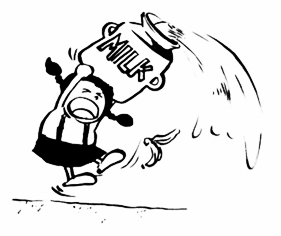
2- To have a sweet tooth/To be sweet toothed: If someone has a sweet tooth or someone is sweet toothed, this person likes sweet things a lot.
Spanish: Ser goloso.
Example: I love confectionery (cakes, chocolates, pastries....). I must admit I have a sweet tooth / I must admit I am sweet toothed.

3- A piece of cake: very, extremely easy to do.
Spanish: estar chupado, ser coser y cantar, estar tirado.
Example: We finished the exam very quickly. Actually, it was a piece of cake.

4- To sell like hot cakes: be sold quickly and in big quantities.
Spanish: venderse como rosquillas, como churros.
Example: Ken Follet's books sell like hot cakes.

5- The apple of one's eye: A person, usually a child, who somebody loves very much; a favourite child.
Spanish: el favorito, la niña de tus ojos.
Example: The second child, Edward, was the apple of his mother's eyes.

6- To be full of beans: very active, lively and healthy.
Spanish: estar rebosante de energía, vitalidad.
Example: After his terrible illness, Ferdinand is again full of beans.

7- To spill the beans: To tell somebody something that should be kept secret or private.
Spanish: contar todo, desvelar un secreto, tirar de la manta.
Example: We tried to keep it a secret from Sheila but John spilled the beans!

8- As cool as a cucumber: Very calm and relaxed
Spanish: tan fresco, como si nada
Example: The walk was long and tiring but she was as cool as a cucumber and wanted to keep on walking !
A similar expression is as fresh as a daisy:(in Spanish) fresco como una rosa .

9- A hard nut (to crack) : A very difficult problem to solve or a very difficult person to deal with.
Spanish: un hueso duro de roer
Example: You'll find it difficult to make him change his mind.He's a hard nut.

10- A couch potato: A person who spends most of his/her time sitting and watching television.
Spanish: no se me ocurre otra cosa mejor que teleadicto (pero en sentido peyorativo).
Example: Cindy
is really angry with her husband because he keeps sitting down in front
of the TV all the time watching sports. She says she's married a couch potato!

SPLIT PERSONALITY
The students' personality changes drastically. A clear example of split personalities.

PRESENT SIMPLE (II)
GRAMMAR CHANTS (By Carolyn Graham)
THIRD PERSON “-S”
Third person “s”,
yes, yes.
Not in the question,
no, no!
Third person “s”,
yes, yes
Not in the negative,
no, no!
Third person “s”,
yes, yes
Not in the plural,
no, no!
Third person “s”,
yes, yes
Third person “s”,
yes!
HABITS
Bob gets up at six o’clock.
He never wakes up late.
He always gets up early.
He never sleeps till eight.
He always drinks his coffee black.
He never uses cream.
He rarely has a sleepless night.
He never has a dream.
He does his breakfast dishes,
then puts them on the shelf,
walks around the kitchen
humming to himself.
HE NEVER SPEAKS ENGLISH IN HIS ENGLISH CLASS
He never speaks English in his English class.
He never speaks English at night.
He never says “Good morning” in English.
He never says “Oh, that’s right”.
He never says “Good evening” in English.
He never says “Have a nice day”.
He never says “Hi, how are you?”
He never says “I’m OK.”
He doesn’t speak English in the classroom.
He doesn’t speak English in the hall.
He never speaks English in his English class.
He never speaks English at all.
PRESENT SIMPLE (I)
GRAMMAR CHANTS (By Carolyn Graham)
DO/DOES
Four little letters,
Does, does.
Looks like goes,
Sounds like was.
Two little letters,
Do,do.
Looks like go,
Sounds like who.
WHEN DO YOU USUALLY HAVE BREAKFAST?
When do you usually have breakfast?
I usually have breakfast at eight.
What time do you get to the office?
I’m usually a little bit late.
What do you have for breakfast?
I usually have coffee and toast.
How long does it take to fix breakfast?
It takes ten minutes at most.
DO YOU ALWAYS GET UP EARLY?
Do you always get up early?
Yes, I do. Yes, I do.
Do you always get up early?
Yes, I do.
Does he always get up early?
Yes, he always gets up early.
Yes, he gets up very early.
I do, too.
Do you always fix your breakfast?
Yes, I do. Yes, I do
Do you always fix your breakfast?
Yes, I do.
Does she always fix her breakfast?
Does she always fix her breakfast?
Yes, she always fixes breakfast.
I do too.


TAKING UP A NEW ACTIVITY
Before doing the listening exercise, have a look at the slides number 38,78 and 88 of the Power Point presentation of phrasal verbs. Then, listen and tick the right answers.
Subscribe to:
Posts (Atom)